Designing a Coordination Value Asset for an Accelerator Network


I was recently asked to design a points-based incentive system for a top-tier accelerator. The brief was deceptively simple: take the enormous informal value that already flows through the network through introductions, mentorship, hiring, and knowledge sharing, and build a system that recognizes it, rewards it, and scales it across hundreds of companies and thousands of people. The full presentation is available as a companion to this article.
I like these challenges since they require game theory, trust primitives, and incentives design that are a core part of blockchain ecosystems. Here the question is not "how do we get people to do more?" The question is "how do we acknowledge what people already do, in a way that earns their trust over time?" That distinction shaped every decision in the design, from the product loop to the budget allocation to the back-loaded equity schedule.
Before I walk through the design, there are a few assumptions worth calling out because they anchor the entire system. The accelerator in this scenario has 500+ alumni companies and over 3,000 individuals in its network. The participants share a common understanding of the value they provide through activities like introductions, mentorship, and knowledge sharing. A $20 million notional equity budget, drawn from the accelerator's portfolio positions, is committed over five years and held in a regulated trust structure. Contributions are verified through a combination of self-reporting, peer attestation, and platform data. The use of AI to make this frictionless is another topic. And the system launches to a 50-person founding cohort before expanding network-wide, because getting the model right in a controlled environment is worth more than speed.
Building on Trust
The core narrative of this system is trust. Gamification is purposefully excluded. This is not crypto casino. There are no leaderboards, not streak counters, no dopamine hitting dashboards.
When I designed the product loop, I deliberately avoided the patterns that most incentive platforms reach for by default. There are no exact point values visible upfront, no public rankings, and no real-time score tickers. The reason is straightforward: when you expose exact point values per action, you turn authentic behavior into calculated optimization. You get point farmers instead of network citizens. The system I designed uses a tiered framework where contributors know whether their activities fall into a low, medium, or high value category, and they receive timely recognition tied to outcomes. They do not need to obsess over a daily score.
The product loop follows a five-step progression: Contribute, Acknowledge, Earn, Trust, and Deepen.
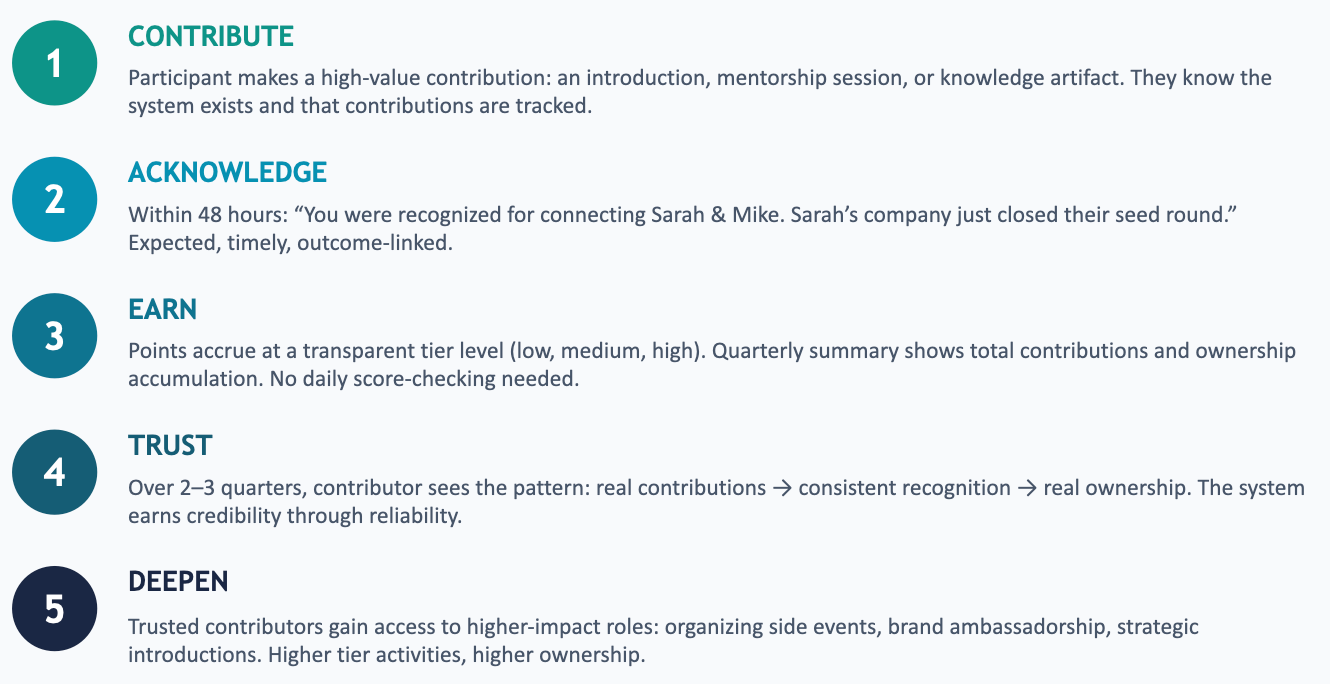
A participant makes a high-value contribution, whether that is an introduction, a mentorship session, or a knowledge artifact. Within 48 hours, they receive acknowledgment that links their action to a measurable outcome. Points accrue at a transparent tier level, and a quarterly summary shows total contributions alongside ownership accumulation. Over two to three quarters, the contributor sees the pattern: real contributions lead to consistent recognition, which leads to real ownership. The system earns credibility through reliability, not through marketing or promises. Once trust is established, the contributor gains access to higher-impact roles like organizing side events, brand ambassadorship, and strategic introductions, and with those come higher tier activities and higher ownership.
This progression matters because trust is the product. If the first cohort does not trust the system, nobody else will.
The People in the Room
Any system design that ignores the diversity of motivations in its user base is going to fail. In an accelerator network, I identified four distinct personas that all need to feel served by the same loop.
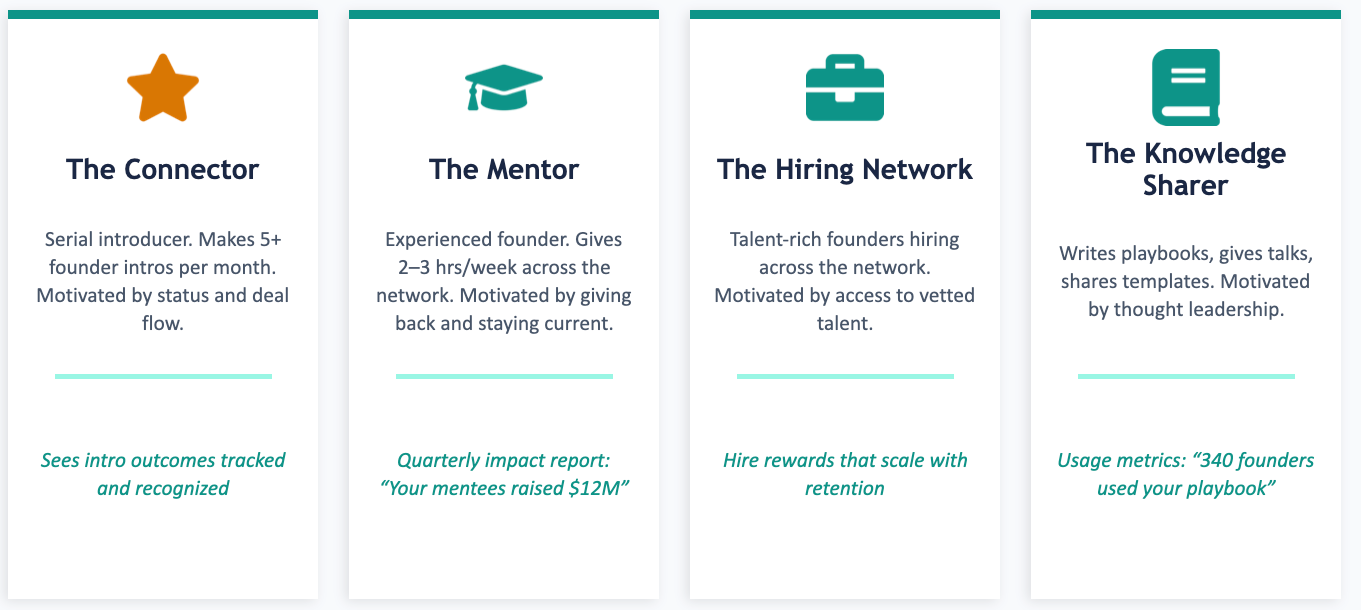
The Connector is the serial introducer who makes five or more founder introductions per month. This person is motivated by status and deal flow, and what they want from the system is to see their introduction outcomes tracked and recognized. The Mentor is the experienced founder who gives two to three hours per week across the network, motivated by giving back and staying current. Their currency is impact reports showing what their mentees accomplished. The Hiring Network consists of talent-rich founders hiring across the network, motivated by access to vetted talent. They want hire rewards that scale with retention. And the Knowledge Sharer writes playbooks, gives talks, and shares templates, motivated by thought leadership. They want to see usage metrics showing how many founders benefited from their content.
Each of these personas interacts with the same product loop, but the feedback they receive is tailored to what matters to them. The Connector sees outcome data. The Mentor sees mentee milestones. The system speaks to each person in the language of their motivation.
How Trust Builds Over Time
I structured the trust-building process into three distinct phases, each with specific targets that I selected to reflect both ambition and realism.
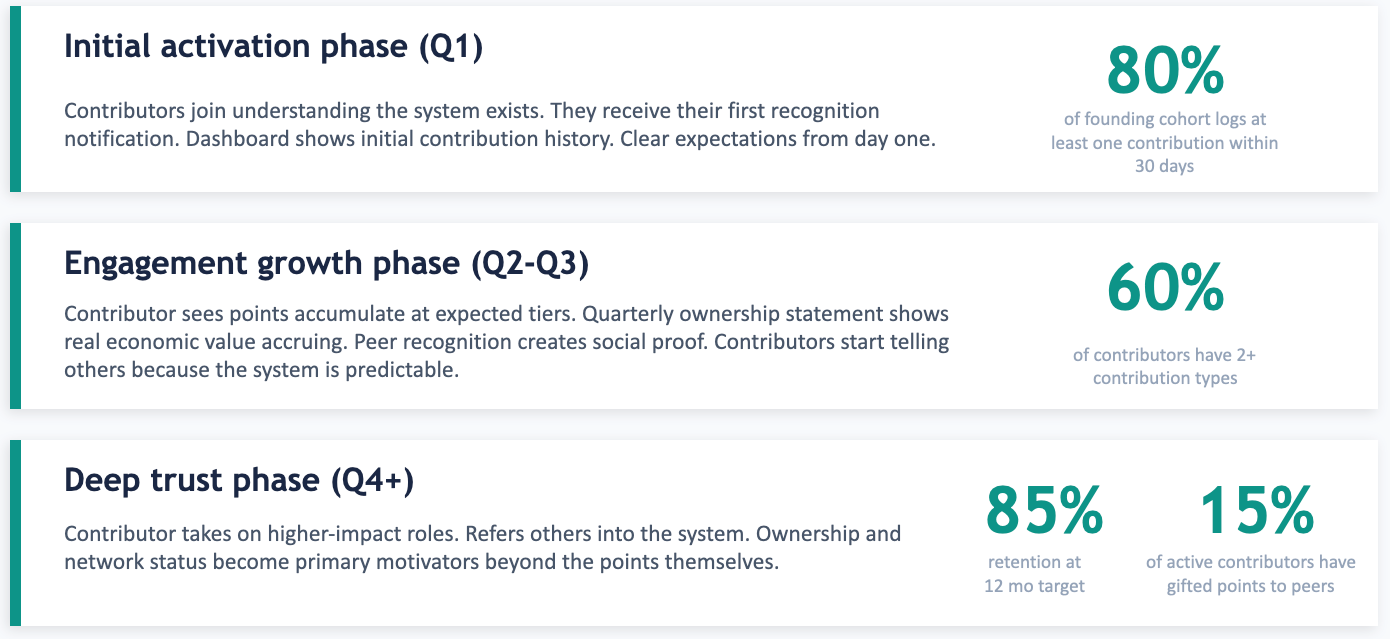
In the initial activation phase during Q1, the target is that 80% of the founding cohort logs at least one contribution within 30 days. I set this at 80% because the founding cohort is hand-selected, and the system launches with retroactive recognition of past contributions. These are VIP users. They join understanding the system exists, they receive their first recognition notification, and their dashboard shows initial contribution history with clear expectations from day one. If the system cannot activate 80% of a hand-picked group in the first month, something is fundamentally broken.
The engagement growth phase in Q2 through Q3 targets 60% of contributors having two or more contribution types. This is a deliberately moderate number. The goal here is not blanket participation but diversification of contribution. When someone who started as a Connector also begins mentoring, that signals that the system is encouraging deeper engagement rather than just rewarding habitual behavior. During this phase, contributors see their points accumulate at expected tiers, quarterly ownership statements show real economic value accruing, and peer recognition creates social proof. Contributors start telling others about the system because the system is predictable.
The deep trust phase starting in Q4 and beyond targets 85% retention at twelve months and 15% of active contributors having gifted points to peers. The retention target is high because, by this point, ownership and network status have become primary motivators beyond the points themselves. Contributors take on higher-impact roles and refer others into the system. The 15% peer gifting metric is perhaps the most important leading indicator in the entire system, and it deserves its own discussion.
Peer Gifting as the Strongest Social Signal
The peer gifting mechanism allows contributors to gift up to 10% of their earned points to other contributors. These points are subtracted from the giver and tracked separately for social signaling purposes.
This is not something the system grants. It is something people give out of the goodness of their heart.
When you have earned your points through hard work, through making introductions that led to funded partnerships, through hours of mentoring founders through their hardest moments, through writing playbooks that hundreds of people used, those points represent something real to you. They represent acknowledged effort and earned ownership. When you choose to take a portion of that hard-earned value and give it to someone else, it is the strongest possible indicator that you genuinely care about the value that person provided to you. No algorithm produced this signal. No system administrator decided it. A human being looked at what another human being contributed and decided, on their own, that it was worth sharing something they worked hard to accumulate.
This is what makes peer gifting different from every other recognition mechanism in the system. When someone tips their own equity, non-participants notice. It tells people outside the system that this network produces value worth sharing, and it creates organic demand without any marketing spend. It is also a powerful quality signal because people do not gift their points to someone who attended an event or shared a link in a Slack channel. They gift their points to the person whose introduction changed the trajectory of their company.
The Shared Asset: What a Person Actually Owns
Points in this system are not abstract credits or speculative tokens. They convert into fractional ownership of the accelerator's portfolio equity, held in a regulated trust structure modeled on the Surus Trust Company.
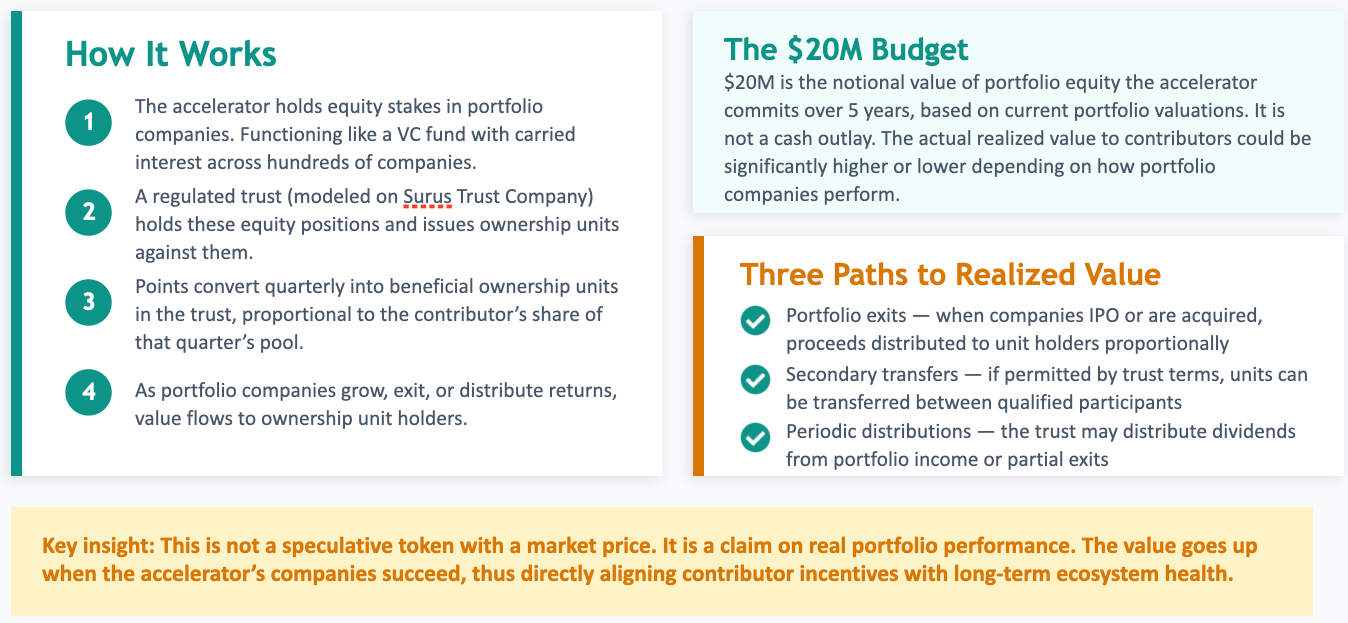
The accelerator holds equity stakes in its portfolio companies, functioning like a VC fund with carried interest across hundreds of companies. The trust holds these equity positions and issues ownership units against them. Points convert quarterly into beneficial ownership units in the trust, proportional to the contributor's share of that quarter's pool. As portfolio companies grow, exit, or distribute returns, value flows to ownership unit holders.
There are three paths to realized value: portfolio exits when companies IPO or are acquired, secondary transfers if permitted by trust terms, and periodic distributions from portfolio income or partial exits. This is a claim on real portfolio performance. The value goes up when the accelerator's companies succeed, which directly aligns contributor incentives with long-term ecosystem health.
Contribution Valuation and the Tiered Framework
Contributors know which tier their activities fall into. They do not see exact point counts, but they have clear expectations of relative value.
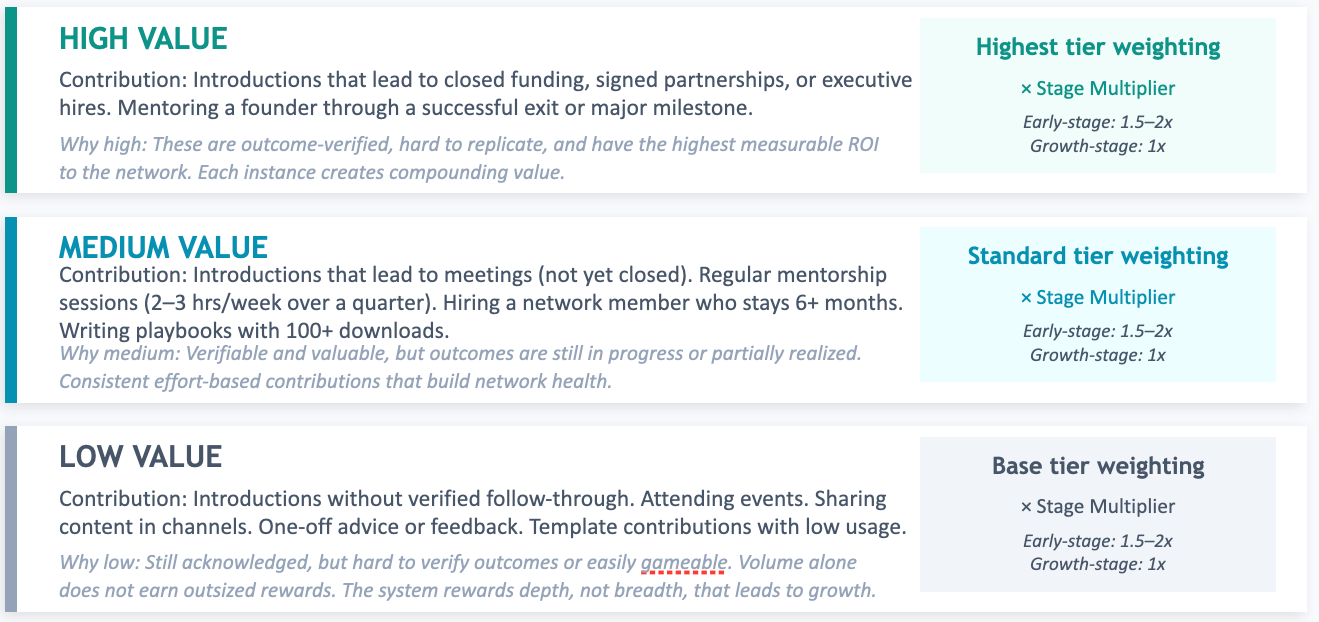
High-value contributions include introductions that lead to closed funding, signed partnerships, or executive hires, as well as mentoring a founder through a successful exit or major milestone. These receive the highest tier weighting because they are outcome-verified, hard to replicate, and have the highest measurable ROI to the network.
Medium-value contributions include introductions that lead to meetings (not yet closed), regular mentorship sessions of two to three hours per week over a quarter, hiring a network member who stays six or more months, and writing playbooks with 100+ downloads. These are verifiable and valuable, but outcomes are still in progress or partially realized.
Low-value contributions include introductions without verified follow-through, attending events, sharing content in channels, and one-off advice. These are still acknowledged, but the system deliberately rewards depth over breadth because volume alone should not earn outsized rewards.
The Stage Multiplier
The same contribution earns different point values depending on the company stage of the recipient. Early-stage contributions receive a 1.5x to 2x multiplier while growth-stage contributions receive a 1x multiplier.
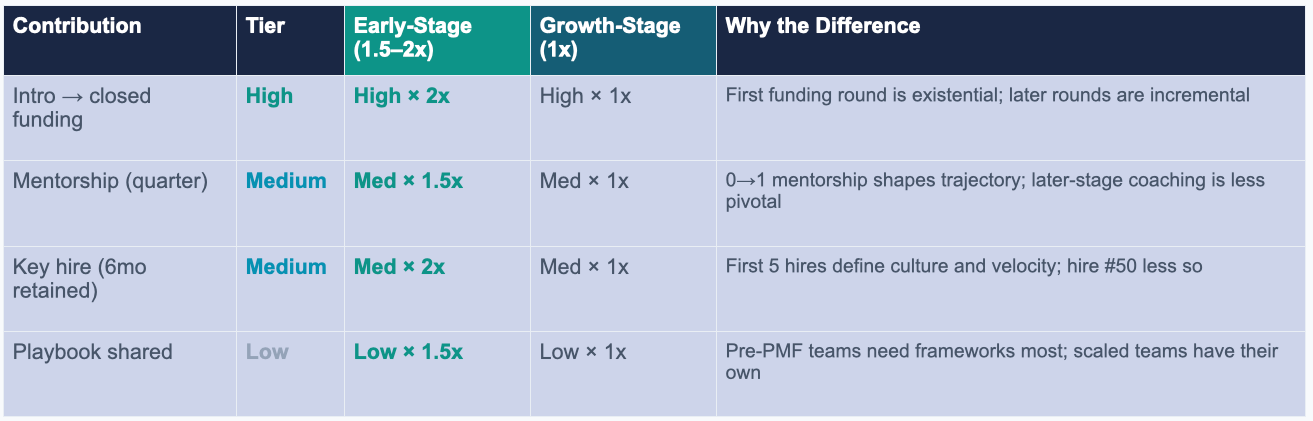
The reasoning here is rooted in the asymmetric impact of early-stage contributions. A single introduction to the right investor or the right first hire can determine whether an early-stage company survives. The first funding round is existential while later rounds are incremental. The first five hires define culture and velocity while hire number fifty is less pivotal. A mentorship relationship when a founder is going from zero to one shapes the entire trajectory, while later-stage coaching, though valuable, is less make-or-break.
This is what matters for the accelerator. The premium is not a penalty for growth-stage contributions. Growth-stage work still earns full tier value at the 1x multiplier. It is recognition that early-stage impact is structurally higher, and that introductions and mentorship at the earliest stages can genuinely make or break startups.
Budget Allocation: Where the $20 Million Goes
The $20 million notional equity budget is distributed across five contribution categories, and the allocation reflects a deliberate hierarchy of value.
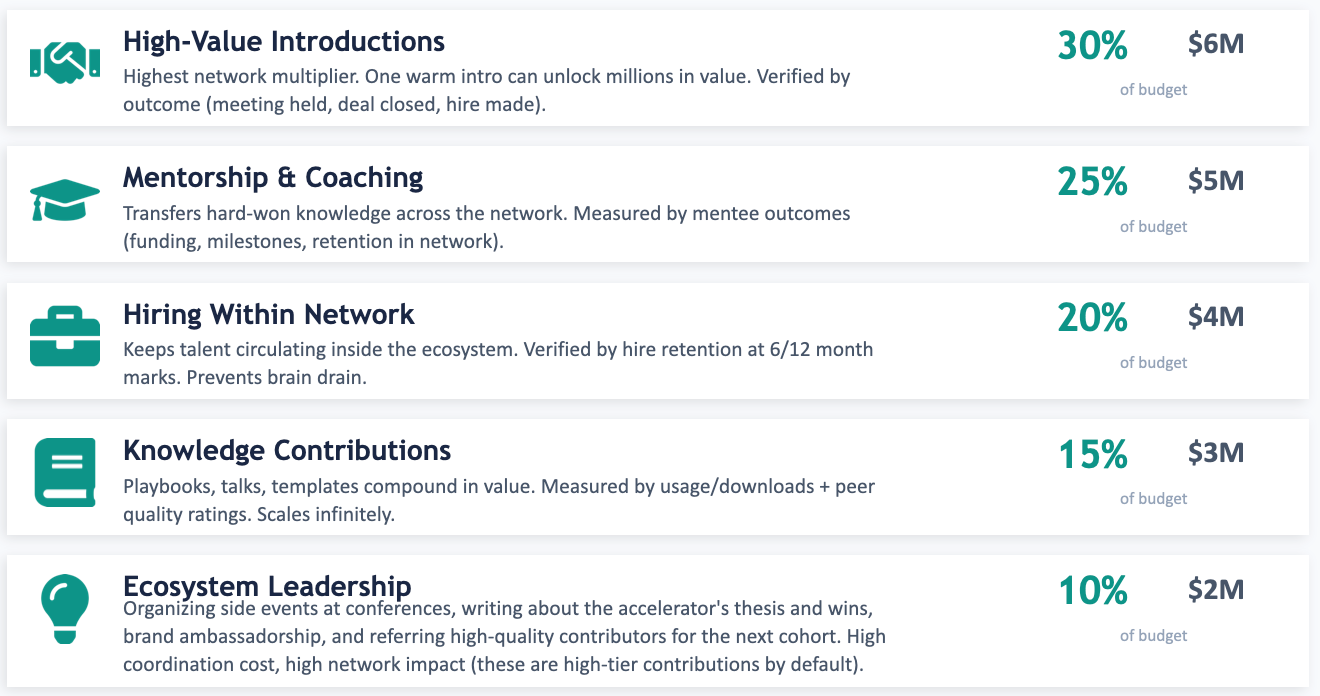
High-value introductions receive 30% of the budget ($6M) because they carry the highest network multiplier. One warm introduction can unlock millions in value, and these are verified by outcome. Mentorship and coaching receive 25% ($5M) because they transfer hard-won knowledge across the network and are measured by mentee outcomes. Hiring within the network receives 20% ($4M) because it keeps talent circulating inside the ecosystem. Knowledge contributions receive 15% ($3M) because playbooks and templates compound in value but are the most gameable category, requiring peer quality ratings as a gate. Ecosystem leadership receives 10% ($2M) because it involves high coordination cost activities like organizing side events and brand ambassadorship that are high-tier contributions by default.
The key insight in this allocation is that introductions and mentorship together account for 55% of the total value distribution. I weighted it this way because these two categories produce the most verifiable outcomes and the highest compounding value for the network. Introductions get the single highest allocation because they have the highest ROI and are the hardest to fake. Knowledge contributions are weighted lower not because they are less important, but because they are the most susceptible to gaming without proper quality gates.
Back-Loaded by Design
Years in crypto industry has taught me a lot about tokenomics and designing incentive systems. My work on EulerBeats has taught me the importance of estimating the growth curve correctly. The first release limited the growth so too few people bought an asset, the second release had a much more generous supply. But in either case there was no end-game in mind and the economic value created didn't transfer to the third release of the project. The moral of the story is that in incentive-based systems you need to understand the behavior you want to drive now and in the future, with a clear value-generating engine to fuel network participation.
So here the five-year equity allocation follows a deliberate back-loaded curve: $2M in Year 1, $3M in Year 2, $4M in Year 3, $5M in Year 4, and $6M in Year 5.
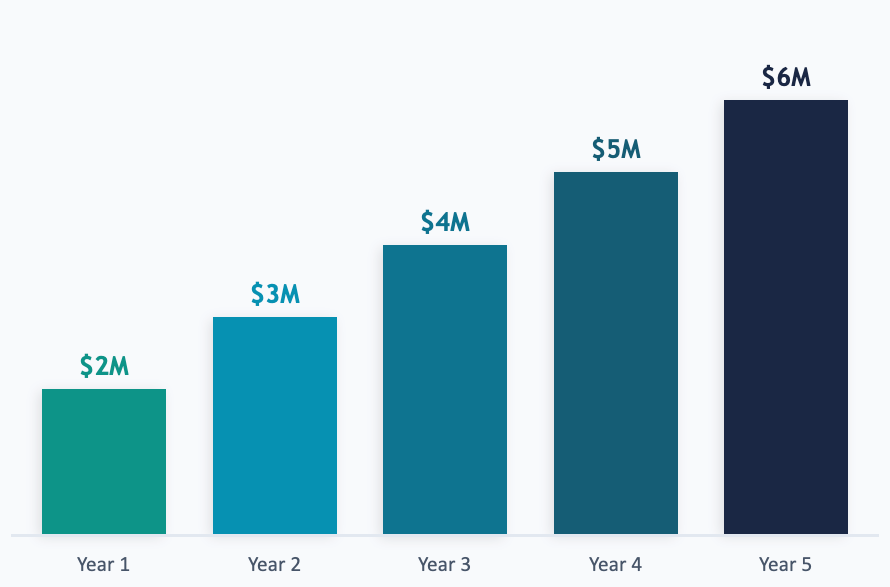
This was one of the most important structural decisions in the entire design. Year 1 starts with the smallest allocation because the cohort is small and the system is building trust. Over-rewarding early sets unsustainable expectations and creates a sense of entitlement that poisons everything that follows. Years 2 and 3 scale to $3M and $4M as the system proves itself and the contributor base grows. Years 4 and 5 deliver the largest pools at $5M and $6M, when compounding value is greatest and the mature network can absorb and distribute the largest rewards.
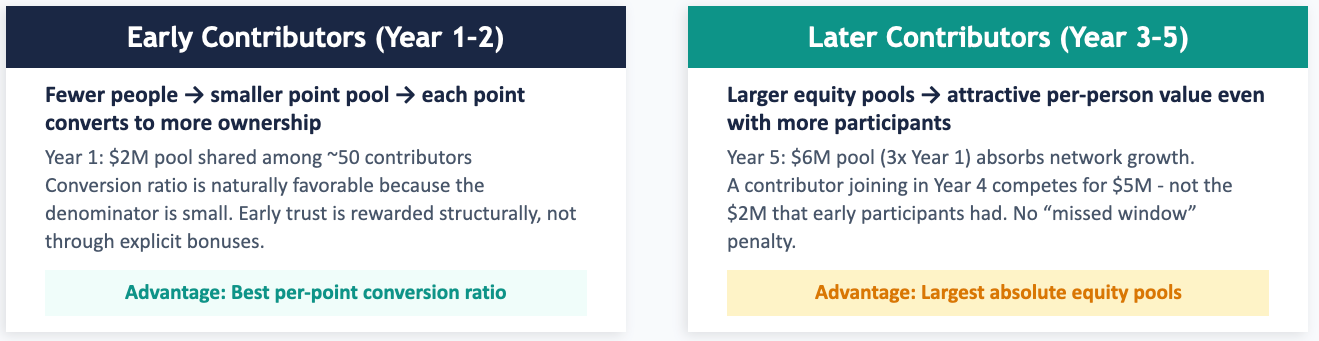
The beauty of this structure is that it benefits both early and late contributors through different mechanisms. Early contributors in Years 1 and 2 share a smaller pool among fewer people. In Year 1, the $2M pool is shared among roughly 50 contributors. The conversion ratio is naturally favorable because the denominator is small. Early trust is rewarded structurally, not through explicit bonuses or special deals. Later contributors in Years 3 through 5 compete for much larger pools. A contributor joining in Year 4 competes for $5M, not the $2M that early participants had. There is no "missed window" penalty.
The result is a system that gets more generous over time, not less. Nobody has a reason to feel they missed the window. Early adopters get the best per-point conversion ratios. Later adopters get access to the largest absolute equity pools. Both are real, meaningful advantages.
The supporting growth levers reinforce this structure. Peer gifting enables organic advocacy because when someone tips their own equity it signals real impact. A cohort-based rollout starting at 50 and growing to 150, then 500, then 1,500 ensures that hand-selected contributors drive demand through their own experience. And retroactive recognition every six months ensures that historical contributions are surfaced and rewarded, because the results of an action may take quarters to materialize.
The Quarterly Conversion Cap
One mechanical detail worth explaining is how the system stays sustainable. Each quarter, a fixed pool of ownership is available for conversion. All points earned that quarter compete for their share of that pool. If 100 people earn 10,000 total points and the pool is $750K, each point converts to $75 of ownership. If 200 people earn 50,000 points, each point converts to $15. The pool is fixed and the per-point value floats.
This guarantees budget sustainability because you cannot overspend. It is self-correcting because low-quality activity floods dilute per-point value, naturally discouraging gaming. It creates scarcity because contributing when fewer others do earns more per point. And it removes the need for manual point-price adjustments that plague systems with fixed point values.
I considered several alternative mechanisms before settling on the quarterly conversion cap. Fixed point values require constant manual adjustment as the network grows, which creates administrative burden and erodes trust every time the numbers change. Uncapped conversion risks a budget blowout if adoption exceeds forecasts. Decay and expiration mechanics punish long-term holders and contradict the entire ownership narrative, and bonding curves introduce too much complexity for a system that needs to be legible to non-technical contributors. Burning mechanisms are interesting but too complex for a first version, something to revisit in Year 3 or beyond. The floating pool model avoids all of these pitfalls while staying self-correcting and sustainable.
The Hardest Trade-Off
By launching with 50 people instead of 3,000, the system deliberately leaves 98% of the network unserved for the first two quarters. This means slower initial growth, less network effect, and risk that non-included members feel excluded. But incentive systems that launch broken rarely recover. If early users game the system, word spreads faster than fixes. A controlled cohort lets us identify and close gaming vectors before they become culture. And the scarcity itself becomes a growth lever: when non-included members see founding cohort members earning ownership, the waitlist drives demand. When expansion comes, adoption is faster because trust has been pre-established by peers.
This is a system designed around a fundamental belief: acknowledge contributions as they happen, even when outcomes take quarters to materialize. Give contributors clear expectations without enabling gamification pressure. Build trust through consistency, not through hidden mechanics. And when someone chooses to gift their own hard-earned points to a peer, recognize that as the most authentic signal of impact the network can produce.
The full presentation deck is available as a companion to this article for those who want to see the detailed framework, risk mitigations, and supporting mechanics.
Constantin Kostenko | kostenko.com | linkedin.com/in/kostenko